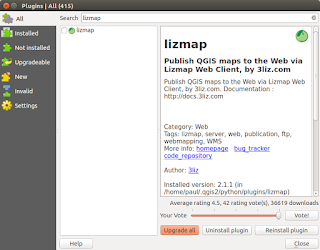
This post follows on from my previous three (most recent first in list) linked below. There is no doubt that in just a short time from now we will probably see a 'one-click' installer to by-pass the next steps but a least this method allows you to change 'in/out' the individual libraries if there is are updates using the usual ' sudo apt update && sudo apt upgrade '. http://www.paulshapley.com/2016/08/qgis-server-bringing-map-into-browser.html http://www.paulshapley.com/2016/07/how-to-install-qgis-server-on-ubuntu.html http://www.paulshapley.com/2016/04/how-to-install-postgresql-95-and.html 1. Firstly...Create a new QGIS project, add your layers from PostGIS, Shapefiles or raster (geotiff), style and symbolise those layers, set the projection and ensure you've set up your 'OWS Server' in 'Project Properties'. 2. Let's install the 'Lizmap' Plugin first by going into the 'Plugins' menu then 'Manage...
I always get frustrated when I update my version of Ubuntu to the next LTS and want to do some development work with the latest stable releases of PostgreSQL and PostGIS. I usually trawl a few web sites to find out what has changed but each time there are slightly different ways of doing the upgrade depending on where you land and who it is doing it. So...to (hopefully) help other people out wasting half a day or so here is my solution. Hope this works for you too... To completely remove all previous installed versions of Postgresql/PostGIS libraries and docs if there is a previous version:- :$ sudo apt --purge remove postgresql postgresql-* :$ sudo apt autoremove Remove old folders:- :$ sudo rm -rf /var/lib/postgresql/ :$ sudo rm -rf /var/log/postgresql/ :$ sudo rm -rf /etc/postgresql/ Remove the old 'postgres' user:- :$ sudo deluser postgres Restart System:- :$ sudo shutdown -r now then:- Update Syste...
GRASS GIS is an extremely powerful application for manipulating and modelling large raster datasets such as Landsat 8 tiff bands. As GRASS users we are aware the application does not implement 'on-the-fly-projections' to ease the pain when adding data in a different projection in the way QGIS does. The grass developers insist doing so would introduce artifacts and some distortions when taking measurements off the overlayed data, so we have to deal with a 'one location = one projection/zone/datum/ellipsoid' combination. How do we get our raster images to underlay or overlay our vectors? The golden rule when using GRASS is if in doubt create a new 'location' any time you want to import or use data in a different projection. I mainly work with just two projections, EPSG:27700 (OSGB36) and EPSG:4326 (WGS 84) and In my case I would define two locations and associated mapsets, one for my everyday working projects in (OSGB36 here in the UK) and one for...
Comments
Post a Comment